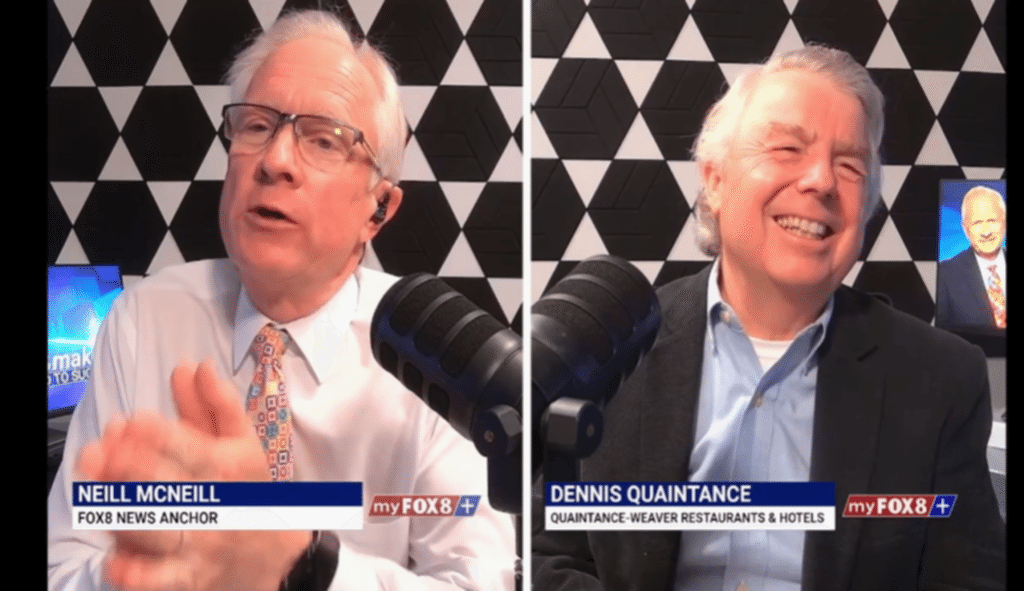
Hello, and welcome to this edition of Newsmakers, The Road To Success, here on MyFox8+, all of the Wghp Fox8 streaming platforms and the Newsmakers Road To Success podcast. I’m Neill McNeill, and we’re so glad to have you with us. Would be hard to find a person who’s had more of an impact on the hospitality industry here in North Carolina’s Piedmont-Triad, than my guest in this episode.
He is the driving force behind a company that has built and currently runs two upscale hotels and three restaurants in Greensboro, as well as a restaurant in Cary, just outside of Raleigh. These hotels include the O. Henry Hotel in its restaurant, the Green Valley Grill, the Proximity Hotel in its restaurant, Printworks Bistro, as well as the Lucky 32 Southern Kitchen on Westover Terrace in Greensboro, as well as its sister establishment on Tryon Road in Cary.
Dennis Quaintance is the chief executive officer, chief design officer, and chief storytelling officer of Quaintance-Weaver Restaurants and Hotels, which is based in Greensboro. And over the next few minutes, we’ll talk about those three titles, how he co-founded and grew the company with his partner, Greensboro businessman, real developer and philanthropist Mike Weaver. But we’ll also talk about Dennis’s complex but inspiring story of his growing up in three different states getting into the hospitality business at the age of 15 and arriving in Greensboro when he was a very young adult.
I hope you’ll enjoy our conversation as much as I did. In Newsmakers, the Road to Success. It is an honor to have you here.
You and I go back a long time, but welcome.
Well, thank you. I’m delighted.
So I’m wondering, here we are when we’re recording this. Gas prices have spiked once again. People are rethinking their travel plans.
You know, they’re cutting back on their extra spending money. As someone who is in the hospitality business, how stressed out are you right now? And, let me rephrase that.
How did your experience with COVID, how is that guiding you now in terms of your outlook?
Well, I’m reminding myself how important it is to breathe in and breathe out.
Yeah.
You know, that there’s just so many sort of moving parts to, you know, sort of the demand side and the wonderful, we have 700 staff members, our wonderful colleagues, and what “responding to and how joyful they are. And so, you know, I enjoy sharing with my colleagues that I believe that fear can be a sign of intelligence, but it’s against the rules to get an ulcer. So, in other words, I try to remember that for myself, too, that, okay, boy, this could go wrong, this is going wrong, this is going to cut the man, this is going to cause these problems.
But if you don’t want to work, you shouldn’t hire out.
Are you already feeling the effects or is it too early to feel the effects now of the inflation and certainly that caused by the higher fuel prices?
Too early because it also kind of fell right when graduation season. There’s a sort of beginning of summer spurt and all that kind of stuff. I think we’ll really know the answer to that by mid-June or so.
But having been through COVID, we’ve learned that you just got to just, you know, the way we like to say it is no matter what, keep cooking.
Right. And you can do that. Yeah.
In fact, I’m going to roll some video here of, this is “a piece you and I did about 18 years ago. It shows you and your lovely wife, Nancy, they’re in action. This is, I believe, in the proximity.
Yeah. No, it’s at O’Henry.
O’Henry, excuse me.
I mean, Green Valley Grill.
Green Valley Grill.
Okay.
I’m glad you recognize.
Oh, no, this is proximity. There was one kitchen and one…
So I’m interested, you…
This is proximity, sorry.
Yeah. Obviously, some luncheon that was happening here. You could have eased off, some might say retired a while back, but you keep going.
Obviously, you’re still having fun. What keeps you going?
I’d literally skip to work. I mean, I think that this happened just within the last few months. I woke up at 3 o’clock in the morning, really worried about something, and so much so I got up and just started working and all that.
And I was thinking about it later in the day, and I thought, you know, if I didn’t wake up at 3 o’clock in the morning occasionally and worried about something, I think I’d wake up at 3 o’clock in the morning worried that I wasn’t worried about something.
Yeah.
You know, it just part of who you is, you know? And so I really like the aliveness that comes from, you know, restaurants and hotels and, you know, all of my colleagues and the vendors and all that, that it’s a joy. And so I promised my colleagues that I will retire when something goes right and I don’t feel joy or something goes wrong and I don’t feel like, oh, my gosh, that if I lose that sort of natural that I don’t, you know, just comes to me naturally, I promise that I’ll retire.
And I also ask them to tell me if they think…
When it’s time.
Yeah, when I’m not the best person to do this and if I lose my sort of spring in my step and everyone’s like, no, no, you have plenty of energy. Don’t worry about it.
Well, I’ve got to think, too, that you’re at a place in your career where there is a little flexibility. So where when you and your wife want to travel or you want to take a couple of days off, you could do that.
Yeah, we can. In fact, you know, one of the promises I make to“my colleagues is that like Thanksgiving and Mother’s Day and Easter and all that, I really know how I can help them. I stay away.
Chief Executive Officer, understand that. Chief Design Officer and Chief Storytelling Officer. Design, you mentioned design.
Now, are you constantly designing things and how much pressure do you put on yourself to continue to keep things fresh in terms of redesigning your restaurants and hotels?
Yeah, I really think that on the ambiance side, the design side, and I have all sorts of resources. Chip Holton, the artist, and Bratch RRL, and my colleague, Jeff Kennedy, and we have all sorts of, you know, so when I say Chief Design Officers, not that I’m doing all the design, but I’m collaborating with others and then we’re implementing it. But our idea is, what I’ve noticed in our business, in our industry, that’s different than it is when we visit, like I mentioned, as we were just in Spain, is that we’re sort of most of, most restaurants and hotels just have a schedule.”
“In seven years, we’re going to remodel. But we don’t do that. I mean, we’ve had, the O’Henry Hotel has been around for 27 years, and we’ve never remodeled.
It’s the same, the lobby looks just the same, but we just keep updating it. And we keep adding little things here and there. And the idea is almost like your home.
What could we do to make this a little more comfortable? And over the last few years, for instance, at the O’Henry, we’ve counted up, we’ve added over 1,000 objects in the guest room corridors, in the guest rooms. We’re just, and we’re buying them from interesting places like Zanke Estate Sales and stuff like that.
So, it’s an absolute joy to endeavor to cause our guests to feel some level of, I’d avoid the word authenticity because it sounds vain. And if you say you’re authentic, then it sounds like you’re crazy. You know, like, how can you say that?”
“But we avoid the inauthentic. So, when we’re looking for design ideas and even, like, most all of our carpets are custom made and we design them and it’s really a wonderful joy and it’s very unusual in the United States. And, you know, now, I mean, most things have gone towards change.
Yes. Chief Storytelling Officer, which I have always found fascinating because first and foremost, professionally myself, I consider myself to be essentially a professional storyteller. I mean, if you bottom line it all, that’s what I do.
How do you define Chief Storytelling Officer?
Well, first of all, I think that the real beautiful lessons that have come to me in my life have come through stories and stories that were sort of delivered by somebody that I could palpably experience as being real. And so I think, well, you know, it’s similar to like working on something on the menu. If you go to a restaurant and you’re like, oh my gosh, this brick chicken is delicious with these roasted vegetables.
Right.”
“Then you come home and try to cook it yourself. And so I want to sort of, my idea is that if I love stories and I learn from them, because it’s sort of, it’s just saying, you know, open that door is one thing, but telling a story about opening a door and why it’s important, and how it changed someone’s life, that’s a real no kidding story that’s about my grandfather, George Moles or something. Then you pay attention.
You’re like zooming in on it, as opposed to just hearing. I think that we tend to dumb things down. And I think stories liberate us to hear a story and then apply it if we choose to ourselves.
This transitions very nicely into the next part of this, because you have quite a fascinating story. And that’s one of the things I wanted to discuss with you today. Born in Spirit Lake, Iowa, the youngest of five children.
And tell me about your family. And I’m going to start with an image here of you and your parents, and that’s you sitting in your mom’s lap there.
Right.”
“And growing up out in Iowa, and I know you moved to Nevada. I think your dad got a job in Nevada. Can you tell me about that?
Well, first of all, I think we dressed up like that exactly once. And it was for this picture. Yeah.
Yeah. What happened was, it’s really an improbable story given this era. But my father rebuilt a little caterpillar tractor and a more conventional tractor to take to Nevada, to help my uncle and grandfather who had homesteaded.
You could still homestead in the early 60s.
For those who don’t know, what exactly is homesteading?
Well, it’s where you can get a section of land. I think it was maybe a half section, which is a square mile of land for free. If you can get possession of it, but you don’t get title until you’ve improved it, have a certain percentage of it under cultivation, built a dwelling, things like that.”
“And then they give you a title so you can get land for free. So near the Duckwater Indian Reservation, just south of where we ended up moving, is where they had their homesteads. So my dad took that out there, and he ran into this fella named Vern Sear, who owned this four-section, four-square-mile ranch, called Current Ranch.
And he asked my dad, entered a contract to buy the ranch from him, and became the foreman of the ranch. So we moved from Spirit Lake, when I was in the second grade, to Current Nevada.
You were seven years old, I believe.
Yeah. Oh, it’s really funny. Our phone number, I’ll never forget this, was Current 3 Ely Exchange.
There was one crank phone in this little restaurant, that we probably served eight people a night.
Sure.”
“And we were, we didn’t get, we couldn’t even get a radio station.
Okay, you were that far out in Nevada.
We generated our own electricity. We had no, everything was self-sufficient.
You also attended school in a one-room schoolhouse. Tell me about that. And for how many grades were you?
Just one.
Just one.
Just a second grade. And yeah, I mean, it was so funny. The school bus was a Chevrolet station wagon, and the teacher would pick us up.
And it was between eight to 10, and I was many as 16 students in there, and most of them were named Quaintance. And no running water or electricity in the school.”
“Your spirit of entrepreneurship, I have read, started when you were in Nevada at age eight, and there was a highway stand, I believe, that you started selling things. What exactly were you selling?
Well, this wonderful man named Joe, I can’t think of his last name now, but he worked for Vern Sear, and we had a little gas station. It was just two pumps out there. And he used to be a prospector, so he taught me to collect these rocks and sell them.
So I had a rock stand.
No kidding.
But I also went out and found, it’s really fun, I found arrowheads and sold those, and found bottles and things like that were distorted by the sun. So I had this rock stand, and the really kind of comical story is, he taught me that there’s a sedimentary rock there that just looks gray, but if it’s wet, it has this wonderful rainbowish striation to it. So he’d say, when you see a car coming, which was from quite a while, he said, just hose off that rock stand, and people will buy these rocks, and he said, just call them Nevada Wonderstone, because when“dries out, they’ll wonder why they bought it.
So I learned about business, but not about ethics.
I hear you. That came later.
Yeah, I maybe did learn about it. I still feel a little guilty about that, but at least it makes a good joke. And if I sell them for a nickel, I mean, no one got hurt.
Your family then moved to Bitterroot Valley in Western Montana because your father got a job in a different business involving horses. Talk to me about that.
Well, I’ll never forget this. I, you know, basically learned a lot of my math, sitting on my dad’s lap playing poker in Current Creek there in the second grade.
How did your mom feel about that? You’re learning poker.”
“She worked so hard, she was already in bed. Yeah, okay. Yeah, she was doing everything.
And, but it was pretty innocent. I mean, there was just four or five people playing poker, and it was sort of, you know, I think the biggest bet was 50 cents or something. But, and these crazy guys came in, they were drunk, and said they wanted to get a couple of cases of beer, but they didn’t have money, and wondered if they would trade us a horse for it, because they had just caught these wild mustangs.
And, you know, dad said, well, show us one. So, I mean, it’s just hysterical. So they bring in this colt, and stand him up in the bar, he’s still-
In the bar?
Yeah, he’s still bloody. I mean, he’s still just born. So he’s slipping around in his own afterbirth and everything, and we ended up buying that horse, we named him Spicy.
I love telling, we halter broke him. He loved root beer lifesavers. So we would halter broke him, but he would walk forward if we had a root beer lifesaver.”
“But anyway, what we learned from those fellas was that there’s a surplus of wild horses, and the government is legal to catch wild horses, wild mustangs. So my dad got in the business of working with those guys and some others, and they had run these herds of horses up into box canyons and then catch them. We were involved in all that, and then, not me, but dad was.
And so he hooked up with this guy named Bud Lake, and he was a big rodeo stock guy, and he was out of Missoula, Montana. And so I’d like to say that the rodeo stock business in that era, my perception is anyway, was in Missoula, sort of like, high point is to furniture. There was a real rodeo stock sort of industry there.
So we ended up there because dad was trucking up Mustangs, wild horses, to Montana, and we decided to move up there and take that on.
Now, I’ve got a reel of family pictures here, and I thought this would be a good time. That’s your dad. His name was Shorty.
Yeah, yeah.
Was he short?”
“Yeah, well, to me, he was rather tall.
Oh, is that the horse?
No, that’s Spicy’s fold in the cold. and there’s my brother, Dwayne, and my brother, Darryl, and that’s me.
You’re the little one. Yeah.
Beside our Pontiac station wagon.
Oh, that had to be in 1950s era.
Yeah, 1959.
Was this in Montana?
No, no, that’s in Iowa still.
Iowa?
And I’m the littlest guy there.
The littlest one.
And you can see Darryl to my left. Oh, and this is fun. To the left is Dwayne, and then it’s LaDonna, and then Darryl, and then Linda and me.
And that’s really fun.
Tell me where all these people are now. Are they spread across the country?
Dwayne and his incredible wife Carolyn live in the Bitterroot Valley, about two and a half miles from Lake Como where this was taken. My sister LaDonna lives with her amazing husband Doug down in Boise, Idaho, and both their children live in Boise. Then my brother Darryl lives near San Luis Obispo, California in Sea Canyon, S-E-E Canyon right near the ocean there.”
“Then my sister Linda still lives in Superior, Montana where she taught school and is now retired.
Do you get to see them? Yeah. What fun places to visit, I’m thinking.
Yeah. Oh, and what wonderful people. I mean, they’re all just regular.
We’ve all taken different paths and they’re extraordinarily wonderful people. I feel really lucky.
Fast forwarding a little bit in 1973 at age 15, that was a milestone because it marked the beginning of your experience within the hospitality industry and you got a job at this place.
Oh, it’s amazing.
This is the Edgewater Hotel and restaurant in Missoula, Montana. How did this job come about?
Doesn’t that look like 1973?
Really does.
It’s unbelievable. It’s right overlooking the Clark Fork River, as you can see, which overlooks the University of Montana and Mount Sentinel. It was just an amazing coincidence that I ended up there.”
“The coincidence started with the school in Darby burned down. It’s an amazing story. We were throwing desks out of the windows as the virus was going on.
It was an amazing situation. But my mother and stepfather, an amazing guy, Dale Moles, decided to move to Missoula because they wanted me in school. Plus, he was commuting to work there, which is about 60 miles.
So anyway, we ended up in Missoula, so I started high school there at the perfectly named high school. Perfectly named. Hellgate.
Okay.
The name for Hellgate Canyon, which is that canyon right behind that hotel. Yeah. And so anyway, I wanted to get a job working on cars or airplanes or something.
And I never, I couldn’t find one. You can get your driver’s license when you’re 15. So I’d worked, I had money, I bought a car and I could pay for the insurance.
Your fascination in cars, your father had a big influence on that.”
“Oh yeah, his racing and he was so mechanically inclined. I was always in the shop with him. You know, I was grinding valves on cars and even airplanes when I was in grade school.
Right. And a fascination with cars that continues to this day.
Oh, I love them. I love cars. Anyway, so what happened is I couldn’t find that sort of job.
And this fella that was in high school with me, we rode the same bus. He said, you know, I’m working as a dishwasher at this place and maybe you could get a job there. And so I said, well, I’ll be a dishwasher.
And he said, well, no, you should imply over at the hotel because I think you’re too short to put the pots and pans away because they’re a real high. So I said, oh, okay, that’s fine. So I walked in to this hotel.
I’ll never forget it. And there was a woman at the front desk, her name’s Rosie. Now she’s Rosie Braybeck.
I can’t remember her maiden name. But and I said, I’d like to apply for a job. And I heard her, she went back behind the front“and she said, oh my God, there’s this cutest little guy out there.
He looks like he’s 12 years old. And so they hired me on the spot.
As a housekeeper’s assistant?
Yeah, yeah, I took out the garbage and restocked the linen rooms and helped in the laundry department. And, you know, I was everywhere. I mean, we’re such a wonderful little hotel that I also helped with events.
And it was, I just loved it. I mean, and I still do. I just fell in love with the whole game of hotels and restaurants.
And this is a question I’ve asked you before, but what did you, what is the main thing you learned as a housekeeper’s assistant here at the Edgewater Hotel in Missoula, Montana, that you carry with you to this day? What is it?
Well, damn near everything.
Okay.”
“Yeah, I mean, no kidding, because I got to see the sort of raw part of it. I got to see, you know, how people, you know, I’d say this probably too often, but I learned that what people expect as guests and as staff members is reasonable and predictable. So just do it.
But people get into their own heads and their own games, and they just don’t do it. So, you know, and having some amazing mentors through being the Edgewater there, you know, I just, I learned, I learned that people, your guests, just want you to be competent and friendly, and your colleagues want you to be competent and friendly. So just go do that.
But figuring out how to be competent takes a lot.
And you have told me before that just knowing that I could make a living helping make people’s day better?”
“It’s unbelievable. If you think about it, all of us that work with QW or in restaurants and hotels, when you get out of bed or you go into work in the afternoon or whatever it is, if you really boil it down, you’re saying, okay, I’m going to go endeavor to cause the people that choose to dine or stay with us, and the people I work with to make their days better. I think you’ve got to be quite a cynic and be in your own head to not find some joy in endeavoring to do that.
Then when you get to deliver it or when you don’t deliver it and you’re concerned that we didn’t come through and you realize that you were not focused or whatever, it’s just a wonderful compass and you can redirect yourself pretty easily and get out of the dramas that we tend to create or live in.”
“Now, you were working, correctly if I’m wrong, at the Edgewater Hotel when you met this guy, his name is Bill Sherrill and we’ll get into his connections to Central North Carolina here in just a few minutes. By the way, he is the founder of the Red Oak Brewery. Many of you will know, in fact, that’s the Red Oak Brewery when it was under construction.
But you met him in Montana. Tell me that story.
Well, he had been leading a barbecue company, Blackwelters, here in North Carolina.
He was from Winston-Salem, originally.
Yeah. His dad was an executive, was Reynolds. He was in charge of all the manufacturing.
He had all kinds of patents. Interesting guy, Joe Sherrill. Anyway, Bill came as a general manager because after he left his role leading that barbecue company, he went off to Cornell and got his master’s degree after studying history at Duke and running that restaurant company.
So right out of getting his master’s degree, he took a job with this company called Thunderbird Red Lion that had bought the hotel.”
“Edgewater Hotel.
Yeah. They changed the name a little bit and all that, but he came to the Edgewater as the general manager. Bill is such an amazing person in all sorts of ways.
But here’s this fellow, comes in sort of bigger than life wearing these shirts that he had made for him. He traveled all around the world. I think he’s visited over 60 countries, over 30 of them in Africa.
He’s an amazingly interesting person and his experiences and his stories are just extraordinary. So I was just fascinating with this guy. And at that time, by the time he came, I was the longest, I had the longest serving staff member at that hotel.
And I’d worked by then, I was working in engineering and moved to the front desk. So I knew all the mechanical systems. Bill asked me to sort of show him around the hotel because I knew all the physical things and sort of give him the backstory.
And we became fast friends when I was 17 years old. And so that was 52 years ago.”
“So you didn’t come to Greensboro immediately after you met. In fact, you went, you left Missoula, Montana and got other jobs in the hospitality industry and several other areas, correct?
I decided that I didn’t think I had the money to go to college. I realized now that I could have figured that out. I mean, no one, I mean, literally, they, so was, I guess, the school I went to because I never took the ACT or SAT.
They were just like, this kid’s not going to go anywhere. And…
Do you regret not going to college?
No, I don’t. I don’t recommend it. I recommend going to school.
Yes.
And I recommend sort of figuring it out. But what I learned is that, if you can learn the vocabulary and really know what you’re talking about and know how to affect things… So, I literally wanted to work in different sort of segments of the restaurant and hotel business.
And I would buy textbooks for like 25 cents and use the glossary. And because I’d always get invited to these meetings. And they would say, I’ll never forget being…”
“Because Bill asked me to move to Seattle after we were in Missoula. Because I’d gone to Phoenix when I graduated from high school and worked at the Adams Hotel there. But when I came up to Seattle, it’s so nice of him to invite me.
And they put me in this training program. I’d go to these meetings and I’d never forget they were in this thing. And Bill started talking about planned obsolescence.
And he talked about, well, you know, we’ve got double declining balanced appreciation on these assets. That causes, you know, the owners to want to do this. So I went and looked up all those words and figured out what things meant.
So I think that my sort of fear of not measuring up caused me to have a real appetite for making sure I knew all the words. So I recommend this to anyone now. If you want to get into something new, don’t be afraid of it.
But know you don’t know anything until you know the vocabulary. And so I learned that just by my own sort of survival instincts. And so no, I don’t regret not going to college.”
“But if you don’t go to college, which I highly recommend, read a lot and move around a lot. Hang out with people different than you. And if you expose yourself to sort of situations that you’re not familiar with and whatever you don’t understand, ask someone to teach you.
And then read about it and verify it yourself.
Yeah, but become a specialist on your own.
Yeah, become an enthusiastic generalist, specializing in every dang thing that you think can cause good things to happen or could avoid bad things from happening.
And that is so important in what I do. Because people, I’m a professional storyteller, but I’m not really a specialist in anything. What I am a specialist in is taking difficult concepts and turning that into English so a mass audience can understand.
I think that’s what a leader of an organization needs to be able to do. You need to be able to talk about things where people can pick up what you put down.”
“I want to fast forward to the late 1970s, and this is how you came to Greensboro. And Bill Sherrill was instrumental in that. Take me to 1978, and what proposal did he hit you with at that time?
I was 21 years old, and he said, Why don’t you come to Greensboro and help me open this restaurant called Franklin’s Off Friendly? And we had talked about this sort of thing for years, and I had gone off to, I worked at Palm Beach at the Breakers and the Adams Hotel in Phoenix, as I mentioned, the Hanford House in Richland, Washington, where the nuclear facility is. I was all over, and got a lot of experiences.
But he asked me to move back here in 1978 to open Franklin’s Off Friendly. And man, I literally wrote my journal. I’m a West Coast guy.
I’m going to do this for two or three years. Who else would give me a job like this at 21 years old? And I wasn’t here a year or so.
And I said, Greensboro is where I want to live.”
“And Franklin’s Off Friendly, for those who may not have experienced that, it was a lovely establishment, diagonally across West Friendly from Guilford College, kind of behind the Wachovia, the Wells Fargo Bank. Now, I started to say Wachovia. It used to be Wachovia, but kind of behind that.
Yeah.
And that’s where it sat. And that was the restaurant. Where did the name, Franklin’s Off Friendly?
Do you know that? What’s the story behind the name Franklin?
Oh, it’s a wonderful story. Bill’s middle name is Franklin. And Benjamin Franklin was a Quaker, in the Quaker School right across the street.
Oh, yeah.
New Garden Friends meeting right across the street.
And one of our favorite restaurants in Seattle when we lived there was Henry’s Off Broadway. So, Henry’s Off Broadway, Benjamin Franklin, William Franklin Sherrill, and we were all friendly, friendly standing down, but we weren’t on friendly. Yes, you were off.
You had to drive around Francis King Road, which is a Quaker guy, to get to us. So, it just was natural to name it Franklin’s Off Friendly. And Bill was so gracious.”
“He included me in all these sort of collaborations. It sort of caused me to be addicted, Bill did, to collaboration.
Right, and you were at Franklin’s On Friendly when you met this lovely person.
Yeah.
She was waiting tables, correct?
No, she was doing everything.
No, she went to Kuhle. So, I would imagine she was back in the kitchen.
She was, here’s what happened is Nancy King was at Cornell, and they take long winter breaks up there because winter is so harsh. And so, she had talked to Bill, kind of a long story, her family is from Greensboro, J. King Company, the Scales Company.
Yeah, so Jim King called Bill Sherrill, her dad, and said, my daughter won’t come home over Christmas break unless she has a job because she’s got a job in Ithaca, and so could you give her a job? And Bill said, sure. So, Bill goes off to Seattle for Christmas, doesn’t tell me about this.”
“You know, Nancy walks in a few days before Christmas and says, I’m here to start my job. And I said, I don’t even know who you are. You know, it sort of ticked me off.
But anyway, so I said…
I could see your response.
Yeah, I mean, it’s December. I’m busy as hell. Yeah.
And so anyway, I sent her away. But anyway, I scheduled her to open the kitchen doing prep and close the bar. I thought, you know, this Cornell’s rich, snot-nosed kid, I was wrong about all of that.
She was snot-nosed. She probably wasn’t, you know, and she, you know, I just had this thing. And I was so impressed by her.
She was just, she did everything with gusto. She was smart. She was nice.
Her co-workers liked her. And she was there for about eight weeks. And I was so impressed.
But here’s the story. So one day, she was, so she worked in the bar. She worked in the kitchen.”
“She worked at the front door. We’re both working the sort of in the front. And one day we came around this corner and just ran smack into each other.
And just bam, and we’re both looking in another direction. And the sort of line when you run into someone in the restaurant business in that era was you’d just say, would you care to dance? So I said, oh, would you care to dance?
And she waited, it must have been a half a second, but it seemed like three seconds. Then she said, yeah.
Okay.
And I was like, oh my God, amazing woman. I think she just like flirted back with me.
Yes.
So anyway.
So the rest is history and you’ve been married 43 years. Married in 1990 and.
No, 1983.
1983. Okay.
Yeah.”
“I was married in 1990. I started here and I knew there was, I started here in 1983, but you eventually became Mr. and Mrs. of the Hospitality business and congratulations on both of your success. And she’s still with you.
Yeah. Yeah. We’re, we’re, we’re soulmates.
Yeah. Nancy and I are, you know, I can’t really tell where she stops and I begin and vice versa.
When you and Nancy, I guess, were at Franklin’s Off Friendly, you met this gentleman, Mike Weaver.
Yes.
And if I remember correctly, you told me one time that Mike was just so nice, you immediately struck up a friendship and he was a regular customer there.
Yeah, I literally kept a journal better than I do now and I remember writing in it. Mike is teaching me that shrewd because he is such a significantly and still is a successful business person.
And major real estate developer, land developer, philanthropist, yes.
I mean, still water runs deep.”
“He’s quiet, but he does a lot of salt of the earth type of guy.
But I wrote in my journal, Mike is teaching me that shrewd doesn’t need to rhyme with rude. You know, he’s just so kind and helpful and thinks of others. And so anyway, yeah, I got to know Mike and, and well, you know, when I decided I wanted to start a business, he’s the first person I call.
Yeah, so that so that was going to be my next question. How did you become business partners? I mean, were you just sitting around Franklin’s Off Friendly one day?
And how did that work?
I decided to leave Franklin’s. In fact, I went to work here in High Point with Dick Behrens. I bet you remember him as an advertising guy.
Oh, yeah. He started a company called Development Services Corporation. And I would help companies figure out new business strategies and stuff.
Crazy that he gave me that opportunity.
Did you live in High Point or did you stay?”
“I moved to High Point. And what a guy, Dick Behrens. So anyway, Nancy and I had gotten married, and we’d started a beer and wine distributing company in Charlotte.
We decided to sell that when we…
You moved to Charlotte?
Yeah, after that. After High Point, I moved to Charlotte. And anyway, what happened was when we decided to start this restaurant hotel company, we worked for another company for three years and multi-unit restaurant management sort of thing.
And I decided I wanted to start this company. So I called… I had a list.
I had several lists, but Mike was the only one on the first page. I really thought he would be the ultimate business partner. So I suggested that I told him I wanted to start a business, I wanted to talk to him about him helping me.
So we went to lunch, and it was one of the most interesting 15 minutes of my life. Because I said, I’d like for you to invest, I mean, to build a building for us, and lease it back to us, I mean, Nancy and me, but she was still working for another company.”
“Sure.
Then I’d like you to loan me $400,000.
Oh my God. So did he hesitate?
He said, I’d like to do business with you, but I think it could really be good, but I’d like to be your partner. I immediately said, not anticipating that he would say that, that I don’t want a partner. I second-guess myself like crazy, and if I have to run decisions by somebody else, I don’t think I can be effective.
I already seek who I think can help me. He said, I’m a really good business partner because I started partnering with my parents in investments when I was only 12 years old. And I’ll tell you what, what if we’re partners, 50-50, I’ll loan the company money as subordinated debt to make sure we have enough, but that will leave us at 50-50.”
“You can put in, Nancy and I had saved up about $50,000. We’ll both put in that amount, and then I’ll loan the company what else it needs. And the only thing that we’ll need to agree on in terms of partners is your salary, and if we’re going to spend more than a million dollars in a year on a capital project.
And I said, well, let me think about that. And I thought, man, how reasonable is that? So that we, and the next day I said, yeah, let’s do it.
And he said, why don’t you come by after lunch? And he had this, I still have it. It’s a two paragraph, half, little more than half a page letter.
It’s the foundation of our partnership. Yeah. He’s so good at the simplicity.
Well, I was going to say, aren’t the most effective contracts the simplest ones? Yes. Just the one or two pages.
Yeah. And we’ve never had to reference it because I deeply respect him, always have. I mean, he’s my teacher.
I mean, he’s just amazing. And I’ve never had to remind him of his part of the agreement either.”
“Okay. So please correct me if I’m wrong, but I believe this was your first restaurant.
Yeah.
Lucky 32 on Benjamin Parkway.
Oh, Westover Terrace.
I’m sorry. Okay. That’s on down the street.
Yeah. I do know Greensboro. I don’t think I would know, but that Westover Terrace right next to Fire Station 5.
This was your first venture.
37 years ago come June 5th. Yeah.
What was your vision going into Lucky 32? And we’ll get into the name here in just a second, but Southern Cuisine.
No. Well, it evolved to Southern. The idea was there’s some wonderful restaurants.
In that era, it was unusual to have open kitchens. So we noticed that restaurants that had open kitchens were busy, and we noticed sort of the size, and Nancy and I had spent a lot of time thinking about restaurants. And so the vision was to bring these restaurants that were popular in larger cities that had relatively limited menus, but really competent execution in terms of hospitality and food to Greensboro, but to have a larger variety because it’s a smaller city.”
“So we needed people to visit more often. And so the idea there is we’d rotate our menus. And it started off that we had have 13 four-week menus a year.
And they were wildly diverse. Like the first one was Caribbean and another one was India. Bill Fret, Cheryl’s friend, Deepak.
And we just had all these different things. So the idea was to have this variety, but also have a set standard menu. And some of the things that are on menus 37 years ago are still there.
Like name one.
Black Bean Cakes.
Oh yeah, love those, love those. All right, the name Lucky32, tell me that story.
Well, my dad’s race car number was 32. And there it is. There it is, yeah.
Shorty Quaintance written on the door.
Yeah, it’s right above the 32, yeah.
And he painted the flames in the 32 and everything on there. It was a Flathead V8 and 1940s vintage Mercury. And he built the car himself.”
“And so, when I was in fifth grade, I don’t know if I’ve ever told you this, Neill, but I wrote a story. We write a story that is based on fact. And I wrote this story that was titled Lucky 32, and told the story about why he retired, his big accident and big crash, I guess you’d call it.
And I won this little prize and I was just so surprised because I didn’t know how to write. And so I developed this alter ego, like if I shot a three throw and make it, I would mutter to myself, Lucky 32. So I had this alter ego that I called myself Lucky 32.
I’ve hardly told anyone that story.
Really? But so the restaurant’s named after a car.
Yeah, it’s named after a car and it’s named after my alter ego. It’s how old I was when we opened it. And I said, if this isn’t a lucky year, oh man, this is going to be bad.
And that was, correct me if I’m wrong, if my notes are correct, 1988? 1989. Yeah, okay, I was close.”
“Fast-forwarding just a little bit, eight years after starting Lucky 32 in 1998, your first hotel venture started and I’ve got, there it is, it’s the O. Henry Hotel. And there was an O.
Henry Hotel in downtown Greensboro that looks a lot like this building.
We channeled.
No coincidence, right?
Charles Hartman was the architect. It was built in 1919, downtown Greensboro. In fact, I met a woman who was at the opening of that one when she was just a little girl.
When she came to our opening.
Right.
And yeah, so we channeled, we pretended like Charles Hartman was still alive and we, with the help of Don Reeves, this amazing person that we called, he wanted to be called the Minister of Design and he called me the Prime Minister. And but he’s just extraordinary. And Don helped us design this amazing hotel, and Mike Weaver was so supportive of building it.”
“I’ve got to stop and ask you, the entire text of O’Henry’s story, The Gift of the Magi, surrounds the lobby. Was that your idea?
Yes.
Well, yeah, okay.
Don Reeves and I talked about it a lot, but you know, the idea, yeah, it’s such a wonderful story, in fact.
No doubt about it.
I don’t know that we do this perfectly every time, but the idea is if you notice someone reading it, when they get around to the second or third of the last panel on the wall, if we, when our colleagues notice it, we take them a small box of Kleenexes because they’re going to cry when they get to the end.
Yeah, absolutely. So you cry, drink your tea, enjoy.
Oh, and O’Henry is such a joy for Nancy and me and for our colleagues. Like, Cassandra Brown’s been there for 25 years. And she’s the general manager.
And she’s just incredible. And she’s getting married Sunday.
Oh, congratulations to her. And we can’t we can’t forget the Green Valley Grill, the restaurant there. And open the same time the hotel did.”
“Yeah. What we did with the hotel is we pretended like Hartman was alive and we were building the hotel, the O’Henry Hotel with his is him as the architect, but using 1998 technology. Then with the Green Valley Grill, it was as if that had been there for a century or so before the hotel was built.
So we had to kind of connect it, but we it was this two-story building that probably the second floor had rotted out of, and that’s where the pockets are for the transformers, for the lighting system and everything. So we had these two fantasy, we’re like just enthusiastic eighth graders. We just run around and say, what about this?
We can do that. And then we put it to the practicality test. We like to oscillate between idealism and pragmatism.
Yeah, I like that.
Love that. So anyway, the Green Valley Grill, boy, the whole thing is I just I’m living the dream. I love doing this stuff.”
“Well, and the dream doesn’t stop there because nine years later in 2007, you would open what is now the four-diamond 147-room proximity hotel, which is even to this day one of, if not the most environmentally friendly hotels in the world.
Well, and I’m glad I mentioned practical and idealistic because the idea that we don’t pay attention to the resources that the good earth brings us just doesn’t seem responsible. But we ought not be crazy about it. So what we did with that and the environmentally friendly aspects of it is we said we want to do everything that we can to not waste energy and material resources.
But we never want our guests to notice anything negatively because of it, only positively. And objectively, we pulled it off. Our guests don’t know that we’re using less energy and that we used a lot of recycled materials.
They don’t care. They just want to be comfortable. They want the toilets to flush and to take a hot shower.”
“That’s exactly right. And we have to mention too, its restaurant Printworks Bistro, well, first of all, Proximity takes the name of one of the Cone Mills textile mills in Greensboro. So does Printworks, which was a part of, was it a part of Proximity?
Or was that a separate plan?
Well, it became known as, I mean, the company became known as Cone Mills, but the original name was Proximity Manufacturing, but then they changed it. And then there was a Proximity Mill, and then Printworks is when they started printing fabric. And we named that, this is, I know I’m telling too many stories, but Printworks, when Mike was out of town, and we were going to name it Blue Denim for Blue Denim.
Blue Denim, yeah.
Because that’s the fabric of Denim, France, anyway. But we realized that was a mistake for several reasons. So we decided to name it Printworks.
And so Mike comes back from Florida after his allergy season. He gets away from here during allergy season, and he says, what are we gonna name the restaurant? I said Printworks, and he just stopped cold.”
“We were out for a walk, and he grabbed my arm, and he said, I can’t believe that, because my grandfather, Edgar Weaver, started working at Cone Mills when he was 14, I think it was years old, maybe 15. And he became, the Cone sent him off to Massachusetts to learn how to print fabric, and he was one of the original managers of the Printworks mill.
Yeah, duh.
Work of invisible hands.
No doubt about it. We can’t talk about the proximity without talking about its energy-saving components. And I’ve got some video here that I’ve shot from that original story from 18 years ago when we were building this, and you and I are walking in with our hard hats.
And, well, actually, first of all, the outside has a fly ash component to it. When we say fly ash, what is that?
Well, it’s what’s left when you burn coal. It’s one of the ingredients that’s left. And it’s bad stuff in terms of you don’t want to drink water that’s been around fly ash.”
“But when you put it in concrete, it’s called in situ, it’s embedded into it. So we were able to use tons of fly ash in the structural and the cladding of it. Look at us.
Yeah. And that forms the building outside, but use the solar panels to heat water in the hotel.
I still need, we plan to put little signs, it’s only been 18 years, but in the showers that say, we hope you’re enjoying the warmth of the sun.
Yeah.
Because that’s where we’re getting the hot water.
Dennis, why go this route with becoming a lead hotel? I mean, did it cost that much more to incorporate it?
It cost more, but we got our money back in less than four years.
So it paid for itself.”
“Yeah, absolutely. All right. Absolutely.
Well, the reason is, you know, Nancy and I went for a walk and said, you know, we don’t have a choice because we had children that in 1998, the year we opened the Boy Girl Twins, Dennis and Kathleen, and we don’t have a choice now. We’re going to have a legacy if we want one or not, because we’ve got these kids. So we said, what do we want them and their kids?
And their grandkids to say about us. And so we said, you know, being just out in the capitalist world without being proactive about something that really does make sense. So let’s see if we can make any sense out of doing something that’s environmentally and socially environment, social environment and physical environment progressive without being weird and stupid about it.
So we didn’t tell anyone we had registered with LEAD because we were not chasing an award. We were only wanted to know what the best practices were. And we wanted to add that filter to our decision making process.”
“Could we, does this make sense? And when heating your hot water with an energy source that’s free makes a whole lot of sense. So we did it and it makes sense and the breakdown rate is low.
It’s great.
Very quickly, I wanted to talk about the ESOP, the Employee Stock Ownership Plan. You decided to go this route a few years back. Very quickly, why?
Why was that important to you? And there’s this wonderful picture of you standing with the employees on the day you announced this.
Oh, it’s a wonderful thing. Yeah, well, a number of reasons. One is that, you know, treat people the way you’d like to be treated if your roles were reversed.
And another reason is succession. We’re all going to get old. We’re all going to die.”
“So Mike and I are not going to be around forever. So who owns the company? Because ownership drives governance.
Governance drives management. So if you’re thinking of succession, start with ownership. Who would have the same values and have the same sort of mojo that we have than the people that work there and their livelihood comes from it?
So we wanted the employees to own the operating company.
So they totally own it now?
100%.
And do you consider yourself working for them?
No, I work for a trust for their benefit. Because they really don’t own it directly. The company is 100% owned by a trust.
And the trust exists. And the only beneficiaries of the trust are the people that work there. They can’t put money into it.
They only gain a share of the beneficiary value by working there. How long they work there and what their earnings are in a given year.”
“One business-related question. Do you foresee the company getting any bigger? I know you have a lucky 32 in Cary.
And I know you have considered making it bigger in years past. Do you like where you are now?
Yes, we like where we are. I would love, and our company would be well-served to build a smaller hotel that’s different than the two we already have in Greensboro. We’d love to do that.
But frankly, with COVID and business travel being down, we’re doing fine as a business, to be clear. But we don’t see a really gap in the market. People that are building hotels, we’re like, what are they doing?
Because the market is not strong.
And there are a lot of hotels going up in Greensboro now. It’s going to be interesting to see.
Yeah, there’s a lot of hotels announced.”
“Announced, true, thank you for clarifying that. Dennis, one final question. What’s been the key to your success?
And what has worked for you?
Well, first of all, Nancy and I decided about 30 years ago to define success, and we decided for us, it’s as if we get to experience ever higher levels of joy, tranquility and enthusiasm. So we have our own definition of success. So I’ll answer your question that I think usually relates to staying in business and having a level of prosperity for the enterprise and that kind of stuff.
I think the key to success in our business career is that we care. I think if you really looked at QW, the core people, I mentioned some of my colleagues, Christine, I could just go on and on. Our core competence is unusual.
It’s sincerity. We don’t want to let people down. We’re worried that we might let people down.
So Martin Hunt and all these folks, Audrey, I could just go on and on. So we genuinely care. So I think the key to our success is matching our sincerity, with systems, sort of like that practical and idealist stuff.”
“Sincerity is kind of an idealistic idea, but then let’s get practical. In other words, I’ve told all my colleagues from the day we started it, is that if our idea is to cause delight for a guest and our colleagues, there’s one thing that you can do all the time that will demonstrate that you’re sincere about that. They’ve been saying this for 37 years.
Wash your hands all the time. Because if you don’t wash your hands, someone’s going to get sick, a colleague or a guest. And if someone gets sick, that isn’t delightful.
That’s right.
So let’s not cause the lack of delight. Let’s not cause pain. Let’s cause joy.
So let’s avoid the most common way we can get someone sick.
Absolutely. Well, Dennis, first of all, thank you again for doing this.
This has only been about 15 years.
Yeah, I think so. I have treasured our friendship over the years. I appreciate you’re always being accessible to me.
And I wish you all the best. You and Nancy for continued success with QW.”
“Same for you and Wendy and December 17th.
Yeah, that’s my retirement date just announced, by the way, in case you were wondering. Yeah, but thank you. And we’ll look forward to seeing you on Down the Road.
It’s always a joy to hang out. I just, it flies by.
Yeah, and such great stories. But thank you. And thank you for joining us for this edition of Newsmakers, The Road to Success.
I’m Neill McNeill, and we’ll certainly see you next time.”